

Dear Monir
In a letter to her late brother, Shanda McManus looks back at their years on food stamps.


Hey little brother, what’s goin’ on? I went to the supermarket today and the cashier was a skinny light-skinned kid with a curly afro. He was the only other black person in the store. Yeah, that’s the kind of place where I buy milk—where black people are not. The sacrifice I make to live in a “good” neighborhood is not seeing anyone black like me. As I drive around town, people I pass rubberneck. It’s like being a safari animal that’s spotted. Strange how I am so used to being the only black person that when I am in an all-black place (a rare thing now), I feel funny and out of place. The formerly wild thing (now tamed) is released back into the wild and she doesn’t know what to do. When your nephew started kindergarten, he came home the first day and said, “Mommy, the best thing about being the only brown guy is that the teacher never forgets your name.”
Yes, I did laugh because it was funny and a little sad too. Gone is my ability to move through spaces anonymously—I have no privacy. You know, as I walk through the supermarket, the other shoppers, white shoppers look at me for an extra beat. The spotlight is on. I live under continual white stares and it is exhausting. I find myself always a little uncomfortable, and in a constant state of low-level alertness. Crazy to think that growing up we never saw white people except for teachers in school. I took for granted not being noticed ‘cause everyone was black like me. I didn’t know how much privacy I had by being surrounded by black people.
Remember that day Mom got fake twenty-dollar food stamps from Miss Jennifer and sent us to Shop N Bag? You stood so far behind me I might as well have been by myself. Shame was thick on your face, tugging the corners of your mouth down. You hated using food stamps. But you still ate those Pop-Tarts when we got home. Me? No, I wasn’t embarrassed. No, not then.
As the kid rings up my groceries it hits me that I don’t think about how much it’s going to be. I know I can pay. I don’t even check the receipt most of the time. I go to the supermarket three or more times a week. The reason is not that I have to wait for more money, but just poor planning on my part. I’ll run out of eggs or peanut butter and have to go back.
For real, little brother, that’s my life now. I know—DAMN. Remember how our food would be gone at the end of the week when we lived on 15th Street? We ate dry Cheerios because there was no milk. When the toothpaste was running low, I cut the tube in half and stuck my toothbrush in to get the last bit. I know, I know, you just skipped brushing until we had a fresh tube. We had to wait until Dad got paid or Mom’s check came. That’s when Mom was real sick, so we didn’t complain. Remember that day Mom got fake twenty-dollar food stamps from Miss Jennifer and sent us to Shop N Bag? You stood so far behind me I might as well have been by myself. Shame was thick on your face, tugging the corners of your mouth down. You hated using food stamps. But you still ate those Pop-Tarts when we got home. Me? No, I wasn’t embarrassed. No, not then.
Later though, after you died, I felt that food stamp shame. I was pregnant, in med school, and unmarried. I needed more money to get ready for the baby. I was getting financial aid from the school, enough to live on for myself, but not enough to cover me and a baby. Even with Steve’s help, it would be tight. I couldn’t work. I was in med school. It would be impossible to hold a job and expect to pass pharmacology or neurobiology or anything for that matter. So guess what? I went to apply for welfare.
The building was brown brick and it was dingy. Inside, there were gray cubicles and yellowed linoleum. It smelled like our free lunch milk mixed with gray mop water. The smell of need. A place where people who didn’t matter went. I sat across from a heavy-set black woman with gray hair that looked like it had been roller set. You know, when you can see the individual spaces the rollers took up. She was trussed up in a gray polyester suit that squeezed tight over her fat rolls, the buttons on her jacket strained to keep closed. Her glasses were perched on her nose and over them she peered at me. Taking my measure. Like being inspected while naked. She seemed bothered and put out, like it wasn’t her job she was doing. She asked prying questions.
“Who else live with you? Do you have proof you’re in school?”
It was like talking through a minefield. I didn’t want to say the wrong thing and be blown up. She acted like it was her own money she was considering giving me.
I left and walked under a gray sky that seemed to press on me. I had to get some more paperwork to qualify. The shame of asking for a handout settled on my back as I walked back to my apartment. Despite everything, was I still going to end up a welfare mom? I remembered your face from that day in the supermarket. Did I really need welfare? Steve said he would help. I was afraid to count on just that, though. You know how Mom would say, “You got to have your own.” I decided to go to the financial aid office at school and plead my case there. Those ladies welcomed me. One white woman, Sue, you wouldn’t notice her in a crowd, she had a kindness around her eyes behind her glasses. She didn’t judge me for being pregnant and, in fact, she was the first person to react to the news with a “congratulations” instead of “that’s a shame.” And it didn’t matter that I was black. You know, how you can tell with some white people it’s just not a thing for them. Sue found me some extra money by crunching and shifting some numbers.
Later, though, after you died, I felt that food stamp shame. I was pregnant, in med school, and unmarried. I needed more money to get ready for the baby. I was getting financial aid from the school, enough to live on for myself, but not enough to cover me and a baby. Even with Steve’s help, it would be tight. I couldn’t work. I was in med school. It would be impossible to hold a job and expect to pass pharmacology or neurobiology or anything for that matter. So guess what? I went to apply for welfare.
When the baby came, Steve was right there. We struggled to feed our baby, to clothe our baby, and to find someone to watch our baby. At every point, he showed me I could count on him, but it took me a while to trust it. I kept waiting for him to leave me hanging. He never did. I kept expecting it. During that daycare scramble, we had to pick a place sight unseen. It was cheap and had openings. No, I couldn’t ask anyone in either family to help. Remember, no one was talking to us, not really. Yeah, there was no one around like you that I could get to hook me up without questions, without paying in pride. The first day we needed to use the daycare, I had to be on the hospital floor early so Steve dropped the baby off. I called and asked him how it was; he paused and then said, “Okay, I guess.” My brand new mommy instincts went off. I hung up the phone and told my attending physician there was an emergency. I jetted out of there and raced back to the subway. By the time I arrived at the daycare door Steve was already there. We went in and our little precious one was in a crowded room with infants, toddlers, and preschoolers. The room smelled of diapers needing to be changed and sickly-sweet baby food. Our baby was in a crib and an older child was trying to poke her with a pencil. But the fact that me and Steve arrived at the same time showed me he was in it all the way and we had an unspoken connection. We figured out another daycare situation.
I did sign up for the WIC (women, infants, and children) program. I got vouchers for food and they didn’t make me feel bad like the food stamps did. Me and Steve had one of those carts that Grandmom used for shopping and we pushed it to the supermarket on our days off to get formula and groceries. Food cost so much. The money we spent seemed to be so little. Thankfully, we didn’t need as much because, when we were working, we could eat at the hospital cafeteria for a reduced rate. I shopped with the vouchers for fruit and vegetables without shame. There was a list of things you were allowed to buy and no, not Pop-Tarts. I was glad formula was on the list; it was so expensive. I backed away from the shelf the first time I saw the price. I mostly breastfed so I didn’t need so much of it, thank goodness. Breastfeeding was a whole thing, but I got the hang of it, and I was kind of proud of myself. Also, it helped me feel less guilty about having to leave the baby during the day. I rented this big industrial breast pump. It was like carrying an anvil in my bag. It must’ve weighed twenty pounds. I pumped in hospital bathrooms while I was on rotations. I had no privacy. Women came in with questions in their eyes or offered unasked-for advice. It was so awkward. A lot of times I had to squat on the floor and turn to the wall. All day my breasts would be hardening up and leaking milk. I was so happy when I was wearing scrubs ‘cause I could easily change the top. Breast pads only did so much. Your niece was partial to breast milk. That formula we scraped up to buy was returned at the end of the daycare day undrunk. Then she’d have a nursing marathon through the night. I was so tired every morning.
I never thought about how Mom was on welfare. She was on welfare until you were seven. Did you know that? It’s a dim memory, but she brought us with her to the welfare office. I pieced it together later. It probably looked just like the one I went to. The same sad decor and sorry office workers. She had to lie and say Dad wasn’t around. I think that’s messed up the way she had to pretend. I think welfare is set up to discourage fathers from staying in the home. Dad did give us as much as he could. Remember how Mom would say, “Don’t tell my business” ? Her face promised a beating if we did. We never answered when those office ladies asked us questions like “Where does your daddy live?”
Mom gave her the excuse that we were shy. No, we were afraid. She would tear us up if we said anything to those people.
That’s why we were Smiths when we started school. But we were really Halls. You remember when Mom and Dad got married in Grandmom’s dining room after Dad’s accident with the gun? I didn’t know they had been secretly married for four years. They kept it a secret because of that welfare check.
Mom got off welfare after, that’s when she worked at the bank. Remember when we used to meet her at the Clothespin downtown? Then she got sick and instead of a welfare check, she got a Social Security check. That was the check we got until we turned eighteen.
Anyway, it is still hard out here to get enough to eat when you don’t have money. That memory stays with me even though I don’t worry about feeding my kids, or myself now. Food stamps tried to fill the gap for us and still try to for a lot of people. But it’s not enough. I thought things would be better by now. But it seems like some things like being too poor to afford food don’t change. Yeah, I know, it’s not fair.
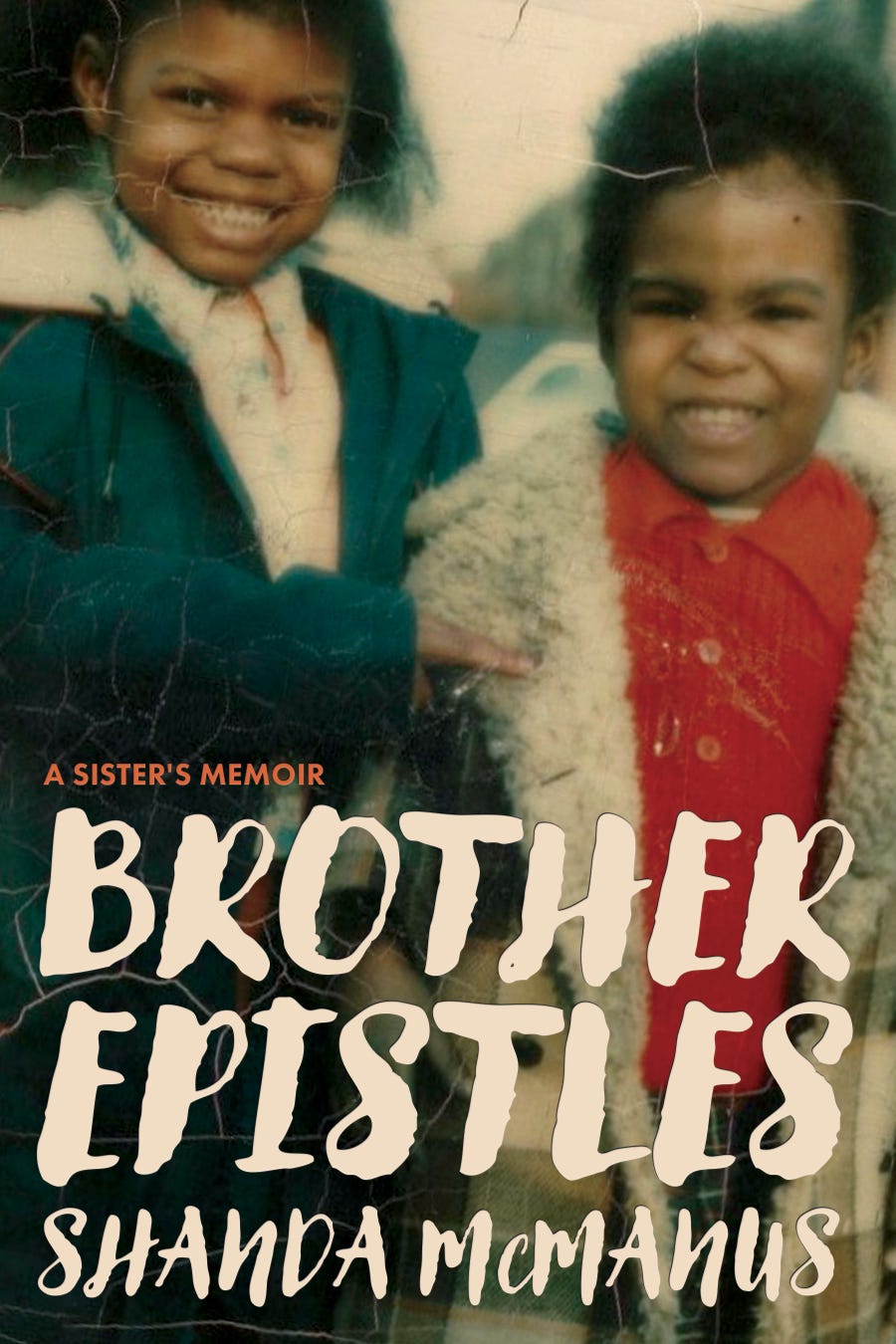
Excerpted with permission from Brother Epistles by Shanda McManus, published by Split/Lip Press, 2026. Check out Shanda McManus’s newsletter, Weatherproof.
|
 | A guest post by
|
This was so compelling. I can't wait to read your book and review it. Also subscribing to your Substack.
I remember buying groceries with food stamps; most of the kids I went to school with didn't live in the barrio, but I'd look around first before getting in line for a cashier.
I can't believe that monster is cutting SNAP benefits while spending billions on a stupid war. No, of course I can believe it.
Beautiful writing. Looking forward to reading your book.