

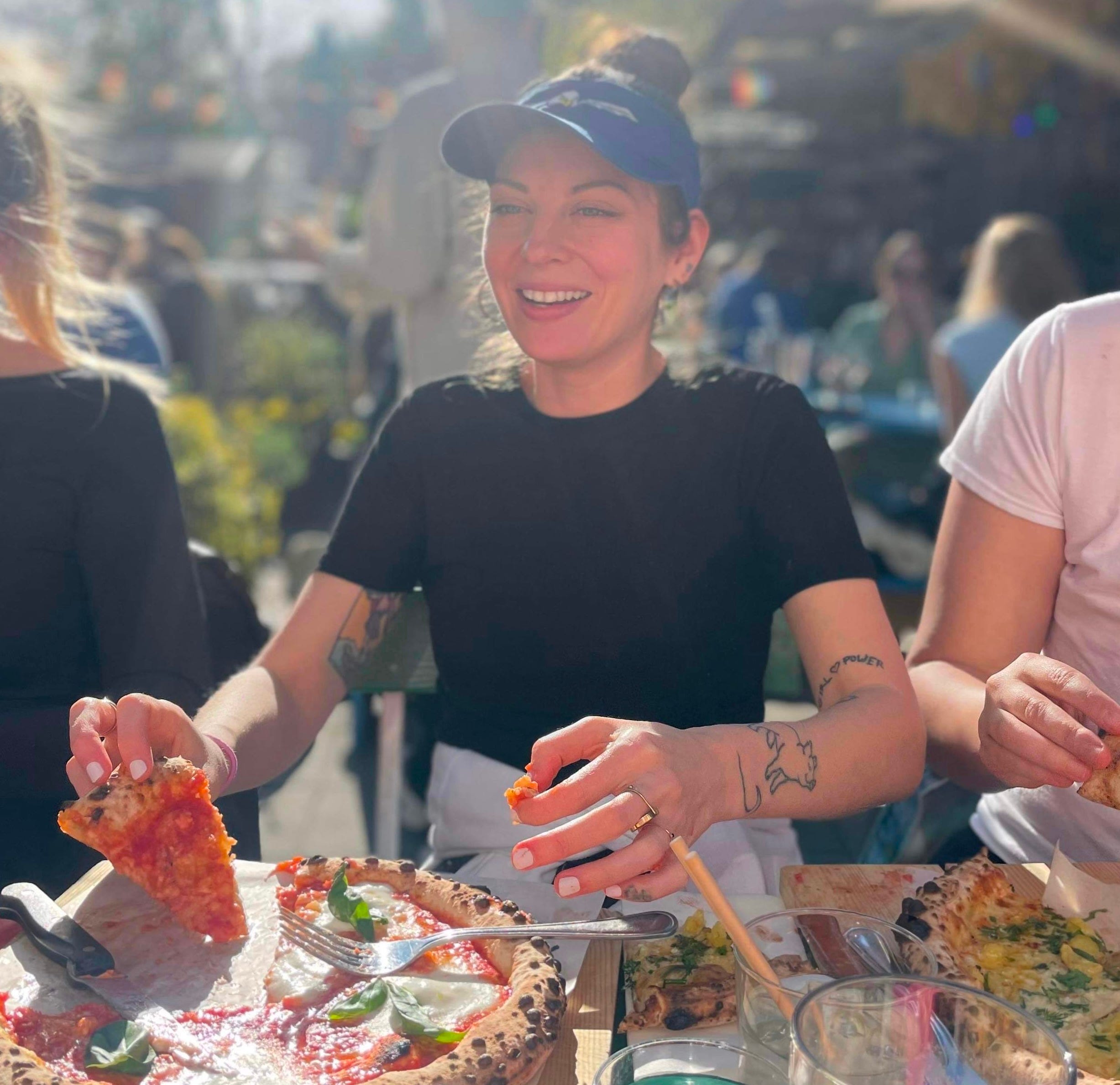
In the fall of 2021, when I was 30, I had dinner at a restaurant with my mom. For years, I would accompany her at the table, where I’d pull out a Tupperware full of quinoa-kale salad drenched in lemon juice, then lie to the waiter about how I couldn’t eat the restaurant food because of a long list of allergies too catastrophic to question. This time, I actually ordered off the menu. An Impossible Burger with fries, drenched in ketchup and mayo. The MyFitnessPal app was deleted from my phone. I wasn’t tallying grams of fat or stressing about daily calorie intake. My mom was happy. Smiling over her own plate, telling me about her day tending the desk at a senior physical rehab facility.
“Oh, you should’ve heard him, Shell,” she said, her soft Southern twang curling around the words. “He can’t swallow good, so he’s on thickened liquids. He took one sip of water, and hollered, ‘What is this stuff? Cough syrup?’”
For years, I would accompany my mother at the table, where I’d pull out a Tupperware full of quinoa-kale salad drenched in lemon juice, then lie to the waiter about how I couldn’t eat the restaurant food because of a long list of allergies too catastrophic to question.
This was her favorite way to bond: sharing our lives over a meal out. For years, I’d denied her that pleasure because of my disordered eating. But something had shifted—a surprising, almost miraculous change of heart brought on by falling in love with someone who had a completely unbothered relationship with food. Sitting across from my mom in a booth, I felt like I was back in her orbit. For her, this was intimacy. And I was suddenly, painfully aware of how much I’d missed—how many moments I’d stolen from both of us in service of thinness.
I didn’t expect these shared meals to be so short-lived. Not long after, her doctor prescribed Ozempic to manage her type 2 diabetes, and just like that, I was the one denied this simple pleasure.
***
For nearly a decade, I suffered from orthorexia. A lesser-known, easier-to-defend eating disorder defined by the obsession with “healthy” eating. Healthy, to me, meant never eating out, tracking every gram of fat, every calorie. It meant cutting out entire food groups—processed carbs, dairy, anything cooked with oil. My meals were repetitive and safe: oats with half an apple, quinoa and veggies, air-fried tofu coated with cornstarch.
I treated Netflix documentaries and diet books like What the Health and Eat to Live as gospel. They reassured me that disease wasn’t genetic—that we inherited eating patterns, not fate. That kind of health-oriented propaganda spoke directly to me. I come from a long lineage of diabetes, strokes, heart attacks. I thought I was destined for the same. But suddenly, it seemed avoidable if only I followed the rules.
I told anyone who questioned my lifestyle that I was doing it to avoid going bankrupt. “Having a stroke in America?” I’d joke. “I’ll never be able to afford it!” I framed it as responsibility. And maybe it was. But I was also obsessed with being thin. More than that, I was obsessed with always becoming thinner, a hunger I’d carried since childhood.
This was my mom’s favorite way to bond: sharing our lives over a meal out. For years, I’d denied her that pleasure because of my disordered eating. But something had shifted—a surprising, almost miraculous change of heart brought on by falling in love with someone who had a completely unbothered relationship with food.
My sister and I are the daughters of a white woman and a Chicano man. We grew up on our parents’ comfort foods: McDonald’s, Taco Bell. Indulgent reverberations of their childhood poverty where food was hard to come by. My mom was one of seven kids from rural Tennessee. I’ve heard stories of all seven kids hungry and crammed into my grandmother’s bed for warmth when the electricity was off. My father, one of six, grew up in Colorado, and spent several falls of his childhood picking potatoes with his whole family to help sustain them. Fast food, for my parents, was luxury. A sign of upward mobility. My mom loved food, feeling satiated, and, most of all, that she could give us kids what she’d lacked.
As a family, we all gained weight. I got my period at just eight years old—something I still suspect was tied to the food I ate. My developing body felt like betrayal. I was still a kid, but I didn’t look like one. I looked like a woman. And I knew that was wrong, because of what I saw on TV: the white girls, tiny and frail. I wanted to be like Mary-Kate and Ashley. I wanted visible collarbones and wrist bones like Victoria Beckham.
Though I’m white-presenting, my sister looks Chicana like our dad. She didn’t relate to white culture the way I did. She didn’t look at blonde girls and think: If I could just be thinner… She couldn’t care less about Britney Spears or Paris Hilton. There was less representation for my sister to compare herself to in mainstream Americana culture, but she clung to icons like Selena and J.Lo, and turned to different IRL communities, like the other Latinx kids at school. Even there, she found pressure to appeal to the male gaze, but she was beautiful and this was easy for her, and she grew confident in her body without needing to physically shrink herself.
I didn’t have that. No boys of any background were interested in me. I had only TV and magazines as the gateway to seeing myself. I was white, blue-eyed and surrounded by images I was supposed to emulate. And yet, I was too big. Too curvy. Too wrong in every other way. I hated it.
My mom and I had the same affliction: we loved fast food and hated our bodies. Our jiggly arms, our bellies, our thighs, traits that my mom blamed on our ancestry. I wanted Gurule legs like my paternal cousins—long and thin. To lose weight, my mom took Metabolife diet pills until they were eventually banned for disregarding serious consumer reports of adverse health effects like strokes, heart attacks and, in some cases, even death. Sometimes, my mom would buy Hollywood juice fasts from Walmart—meant to be diluted and consumed over five days. No solid food. You could lose up to 20 pounds in a week, the label promised.
I didn’t expect these shared meals to be so short-lived. Not long after that dinner, my mom’s doctor prescribed Ozempic to manage her type 2 diabetes, and just like that, I was the one denied this simple pleasure.
I was too young for diet pills, but I craved them the way other girls craved their first boyfriends. I longed for the day I could diet alongside my mom. That was the world I knew: McDonald’s or crash dieting with cheap products. We didn’t “eat healthy.” We didn’t exercise. So at age 12, too young for pills, I did what I heard all the Hollywood starlings were doing: I started restricting.
I kept a calorie log in a spiral notebook. I refused to eat out. I only wanted frozen meals—Lean Cuisines, Smart Ones. That was my idea of healthy: one frozen dinner, one Nature Valley granola bar, one Yoplait Light yogurt per day.
“You have no tits and no ass,” my sister would eventually say, when, by the start of eighth grade, I’d lost thirty pounds. “It’s not hot.”
But no one on The O.C. or Gossip Girl had curves either. They had small chests and thigh gaps. To my displeasure, even as hungry as I was, I still had my same thighs.
***
To my mom’s satisfaction, she lost weight quickly on Ozempic. But without exercise, she lost muscle too. She looked thinner, sure, but not healthier. My sister and I would watch, concerned, as she forced down just one or two bites at dinner. Everything repulsed her. “I can’t even walk around the mall because the smell of Cinnabon makes me nauseous,” she said. But I could hear it in her voice—there was pride there, too. A sense of achievement. It was like she’d finally unlocked the ultimate willpower. “I don’t even want to smell it!”
Within a few months, my mom’s legs looked like toothpicks, and her face was gaunt. People would say, “You’re too skinny,” and she’d repeat it to me like it was a compliment. I understood. During my own eating disorder years, I took pleasure in being told I looked too thin. Even now, it’s hard not to flinch when someone says, “You look better. Healthier.” It’s hard not to hear: you’ve gained weight and perceive that as a social failure.
Beyond appearances, my mom was exhausted. After work, she’d come home and crash in bed. This bubbly, playful woman we’d always known suddenly had no spark. My sister and I began to worry something serious was wrong. Cancer? Kidney disease?
Eventually, we convinced her to go to the doctor. After blood tests, colonoscopies, and scans—and $4,000 she didn’t have—the verdict came in: her health was fine. It was the Ozempic that had drained her.
She was taken off the medication, and her appetite came back with a vengeance. She regained some of the weight, though not all, and this depressed her. “I’ve gained fifteen pounds,” she’d announce every time I saw her. And I’d watch her flinch when I said, “You look better. Healthier.”
For twenty years, I lived in patterns just like hers. I spent all of high school and my early 20s trapped in a cycle of restriction and bingeing. My weight was constantly in flux, and my self-worth rose and fell with it. I only felt good when people worried I was too thin. At 23, a breakup shattered my appetite and stole 34 pounds from me without my trying. Everyone said they were worried, but I claimed I’d never felt better. In truth, I spent the next seven years in the clutches of orthorexia, desperate to maintain a frailty born of heartbreak.
After decades of disordered eating, it still feels miraculous that I was able to step away from it. I fell in love with the person who is now my wife, Daisy. They didn’t subscribe to the same bodily expectations. They saw those ideals for what they were: unachievable by design. Daisy cooked for me. They made me salads with walnuts and olive oil, served cheese without shame, and kept dishes of jellybeans and dried cherries on the counter. I wanted to eat Daisy’s love and care. It felt healthy, but not in the punishing way I’d once pursued. It felt abundant. I was full. I was nourished. And I couldn’t imagine going back.
Watching her now from this new perspective has been eye-opening. For the first time, I don’t want to join her. I want to feed her—luxuriously and lovingly—the way my wife feeds me. But I know I can’t change my mom’s relationship to food, her body, and her health, because these things are tangled up in something deeper: a childhood wound of scarcity that never healed.
Soon enough, my mom was back on Ozempic. Her diabetes numbers had been high again. I watched her smile as her appetite vanished and the weight dropped off again. She’s been cycling on and off the medication ever since. Locked in a new pattern of branded restriction and fast food bingeing. I tell her that her weight doesn’t matter. That we just want her to be healthy. And I mean it.
Watching her now from this new perspective has been eye-opening. For the first time, I don’t want to join her. I want to feed her—luxuriously and lovingly—the way my wife feeds me. But I know I can’t change my mom’s relationship to food, her body, and her health, because these things are tangled up in something deeper: a childhood wound of scarcity that never healed.
My therapist often reminds me of Maslow’s hierarchy of needs. You can’t reach enlightenment without first having security. I grew up in a food surplus—even if that meant McDonald’s on a credit card—because my mom made sure I never went without. She met my basic needs. That foundation is the only reason I was able to heal at all.
My mom didn’t get that same start. But I did, and now I think of my future children I’ll have with Daisy. Kids that can’t be far away now. I think about the patterns I want to pass down to them—the ones I’ve learned from my own long struggle and the new ones I’ve learned from love. How to feed themselves. How to enjoy it. How to trust their hunger. How to live in a body with care and without shame.
And maybe most of all: how to have a secure relationship with their next meal.
Such a real and important essay. Women’s relationships with food in modern society is so complex. If only the focus could be health. ( real nutrition)! I’m glad the author has found balance.
Great article. As someone who had an eating disorder at a very early age (10), this hits home. At 61, I have a very healthy relationship with food. I eat out, eat healthy, and don’t restrict entire food groups. I am fit and have a healthy BMI - but occasionally miss those super fit and lean years when I was younger. I am concerned about the number of people who lose drastic amounts of weight on Ozempic and similar drugs. I realize that some need it for health reasons, but many just want to be skinnier than their body wants to be. Surely this is not a healthy trend?