

Spine
An excerpt of Darcey Steinke's 'This Is the Door: The Body, Pain, and Faith'

The onset of my pain was not actionable; that is, it did not result from a car crash, fall, or work injury—the kind of pain that occurs on assembly lines or in warehouses or even on movie and television sets. One of my students, a young artist named Neil Flowers, worked as a production assistant on television shows. The onset of his pain was specific. One day, from a raised truck, someone passed him a monitor that weighed two hundred pounds. His spine compressed and was damaged immediately. Neil can’t sit for longer than twenty minutes. In my class, he either stood or knelt at our conference table, his face pale and ridged. He told me that after his injury, the hardest thing was dealing with the clock: “I could no longer move along with normal time.” He made the decision to become an artist in part because it was one of the few jobs he felt he could do. His art is enlivened by his pain. A recent work shows identical images of him doing physical therapy exercises—shoulder retraction—on top of a desk in an empty office. The artwork, titled Exercise to Improve Workplace Productivity, questions what sort of productivity is possible in a broken body.
Unlike Neil’s, my moment of rupture was intimate. I was lying on my comforter in my attic bedroom in Brooklyn. It was dark out the window, just a streetlight reflecting in the windshield of a parked car below. Next to my bed, a small lamp threw a wobbly oval of gold up onto the slanted ceiling. My husband had come up to lie beside me on the bed to talk, and I was scooting over to make space for him when I felt a muffled snap, like a wet branch breaking.
Odd that I injured my back not by falling, but in bed, a place I associate more with pleasure than with pain. But my pain is also a kind of passion, one that can be quieted somewhat by memories of bliss. I used to think that the afternoons I spent when I was young in bed having sex, while fun, were mostly a waste of time. Now I realize I was laying up ecstatic sensations for later. These reserves can’t block out pain, but they help to remind me that my body has many capabilities. “Pain,” wrote Mexican artist Frida Kahlo, “does not chase out pleasure.”
Kahlo, who is as recognizable as the Virgin Mary, is known as much for her art as for the story of her pain. A bus crash when she was eighteen bounced Kahlo’s body forward and a handrail pierced her abdomen, “the way a sword pierces a bull.” A ceremonial knife slicing into a sacrificial animal. The scene was surreal; time was “deaf, slow and dreadful.” The handrail severed Kahlo’s clothes, and a satchel of gold dust carried by a housepainter burst, covering her body. Her friend carried Kahlo’s glittery bloody body to a billiard table in a nearby shop window. All she could think about was her frilly umbrella, now lost in the wreckage.
Kahlo’s spinal column was cracked in three places; she shattered her collarbone and three ribs. Her right leg was fractured and her pelvis was broken. She spent three months in the hospital and eight months home in bed. “Death dances around my bed at night,” she wrote to a friend during this time. “At ten o’clock I was screaming until six . . . until they gave me cocaine and this is what made the pain go away.” She called death “la tía de las muchachas,” the aunt of the girls.
In this new reality, time moved sluggishly. There were elongated periods of screaming. Death showed up as the monstrous aunt of terrified little children. This world, as nightmarish as it is, is also liminal, containing eerie metaphysical information. “It’s as if I had learned everything at the same time,” Kahlo wrote in a letter, “in a matter of seconds.” It’s like the hallucinatory sequence in a horror movie, both slow and fast, that pretends to be about terror but is in actuality mimicking the perception of intense pain.
Pain is claustrophobic, not only because we are trapped in our damaged bodies, but also because our spiritual ideas are shaken, possibly even obliterated. “I know now that nothing lies behind,” Kahlo wrote on her realization that there was nothing beyond our material world. “If there was something, I would have seen it.”
Kahlo does not mention God in any of her letters, journals, or interviews. Besides art, she had a variety of strategies to live with her pain. After a later surgery, she wrote, “At least the baldy didn’t get me,” mocking the death skull. Each morning, when at home, she said “Hola, Mama” to the papier-mâché skeleton she kept beside her bed. Her friend Bertram Wolfe remarked that Kahlo had the richest vocabulary of obscenities of any women he had ever met. She called stuck-up people “Grande Cacas,” big shits. In letters, she even made up swear words in English, like fucbulous, a combination of fuckery and fabulous. And she could be bawdy—when her nephew showed her a scapular of the Virgin Mary that a nun had given him, Kahlo told him, “Go tell that little nun to screw her mother but not you.”
Vulgarity itself is a form of pain relief. A recent study showed that volunteers who swore as they held their hands in ice water had higher adrenaline-producing heart rates and less pain than those who made up swear words like twispin and fouch. Swearing, writes Richard Stephens, senior lecturer in psychology at Keele University in England, “brings on emotional responses that produce natural analgesic, a pain reliever.” He goes on to point out that the final words of pilots killed in air crashes captured on black box recorders almost always feature swearing. “This emphasizes a crucial point,” Stephens writes, “that swearing must be important, given its prominence in matters of life and death.”
“Frida,” one friend remarked, “lived dying.” After Kahlo’s accident, her mother suspended a mirror on the underside of the top of her canopy bed so she could use herself as a model for her painting. Before the accident, she had hoped to be a doctor, but as with my student Neil, the onset of pain forced her to change her path. Kahlo’s first self-portrait was painted in 1926, and she continued to paint herself in every phase of her life. These works featured not only Kahlo’s face and upper torso, but also all manner of props: monkeys, parrots, butterflies, clocks, flowers, shells, bloody thorns, and white lace. In one painting, a skull and crossbones sits inside her head, death located just above her famous unibrow.
Many art critics claim that Kahlo’s self-portraits depict the artist as she wanted to be—beautiful, elegant, without pain. To them I ask, Have you looked closely at her eyes? Eyes that are distant with pain, as in Self-Portrait with Necklace, eyes that are bright with trauma, as in Self-Portrait with Monkey, eyes defeated by pain, as in Self-Portrait with Loose Hair. “The only good thing,” Kahlo wrote after one of her many operations, “is that I am getting used to suffering.”
Kahlo’s work is influenced by Mexican folk ex-votos, small paintings on tin that depict the suffering of saints as well as laypeople. An ex-voto evokes what happened in reality but also the supernatural intervention behind the event. A house falls on a family but kills no one. Soldiers come into a house and start firing, but the family successfully hides under a bed. A man on an unbroken mule falls off a cliff but does not die. A sick little girl nearly loses her eyes, but because God intervenes, her vision is saved.
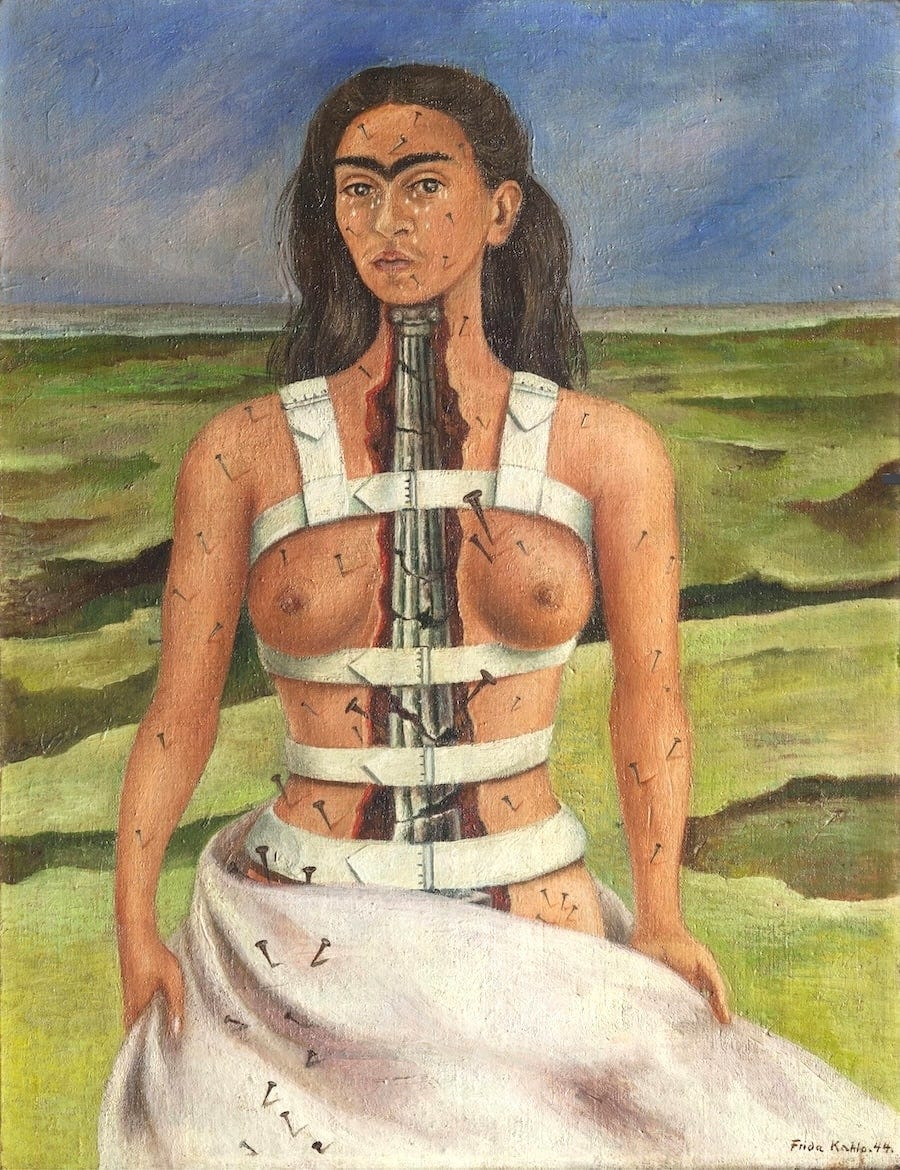
Kahlo’s body, in many of her paintings, is in bloody disarray, but unlike an ex-voto, no easy supernatural salvation is available. She lies on a blood-soaked mattress; thorns bite into her neck, producing drops of blood; her heart, cut out of her chest, stains her white skirt; she lies on a gurney, two red wounds carved into her lower back. In a late painting, Kahlo sits in a wheelchair before an easel. Her heart is the palette; and her blood, the paint. These works hold on to the mystical energy of the ex-voto but also question why we have to suffer. Kahlo’s damaged body confronts the viewer, making clear that miracles, in our rational world, are not available.
I’ve always assumed Christianity was responsible for the idea that we should be grateful for, and quiet about, our suffering. But long before the beginning of Christianity, around 300 BCE, Stoics insisted that we suffer in silence. In her book The History of Pain, Roselyne Rey explains how early Stoic philosophers, while making it clear that pain was not evil, also encouraged devotees to bear their pain impassively. They were the first to argue that we could separate the sensation of pain from our emotional response to it. It was because of them and their highly deliberate system of denial, invented to preserve individual liberty and protect a person’s autonomy, that the idea of silence around pain became common.
“Suppose for a moment,” writes Anne Boyer in her book The Undying, “the claims about pain’s ineffability are historically specific and ideological, that pain is widely declared inarticulate for the reasons that we are not supposed to share a language for how we really feel.”
Kahlo’s work, which André Breton described as “a ribbon around a bomb,” is a direct assault on this silence. In paintings like The Broken Column, she places her broken body at the center. Her body is split in two, and a cracked column along with a corset made of leather braces holds her up. Her pain, like St. Sebastian’s, is personified by dozens of nails digging into her flesh. Tears flow out of her eyes. Kahlo is nude, but her body is not erotic, the typical way we’ve been trained to see female nakedness. She breaks the objectifying gaze, splinters it with her depiction of suffering so that her own spiritual struggle can pour out.
What can be learned from this struggle? What are the things Kahlo had faith in, that gave her some relief? The drive to make art, to express our unique suffering, to reach truth and beauty by daily labor, by ritual, is an affirmation of life; it is a form of faith. Or as Emily Rapp Black writes in her book about Kahlo, “Pain became somewhat silenced by the act of creation.” So Kahlo turned to art-making. Also, revolution. Kahlo considered revolution both a natural reality and a hoped-for utopia. During a later stay in the hospital, she insisted visitors sign a letter she had pinned to the wall in support of the Stockholm Peace Conference. In her journal, she affirmed her commitment to the struggle: “I have to fight with all my strength to contribute the few positive things my health allows me to the revolution. The only true reason to live.”
Kahlo also had faith in medicine and in her doctors. She had friendships with many of her physicians. In one painting, she depicts Dr. Juan Farill as a saint. Some critics have suggested that Kahlo was a victim of failed back surgery syndrome, in which patients get caught in a loop of failed surgery after failed surgery. One article speculated that Kahlo may have had a form of self-directed Munchausen syndrome—that most of Kahlo’s surgeries were elective and that she may have wanted to harm herself because living in pain was the only way she knew how to live. Another article proposed that the artist may have been molested as a child, as early abuse is associated with nonspecific chronic pain. There is no proof of any of these claims. People tend to want to find answers for long-term anguish like Kahlo’s, to find a reason that might assuage and explain her suffering. Rather than retreat from it, Kahlo confronted her pain directly. Although she wanted to be healed, her idea of what that might mean was unique—pain not cured, but seen, shared, known.
In Kahlo’s day, besides surgery, another common method to combat back pain was the plaster “turtle shell” corset. From 1944 on, Kahlo would wear a corset made of leather, steel, or plaster of Paris. “Imagine,” Kahlo wrote in a letter, “they hung me by just my head for two and half hours, while the cast was dried with hot air, but when I got home, it was still completely wet.”
The plaster corset was developed in 1872 by Dr. Lewis Sayre, an orthopedic surgeon in New York City. Sayre was a debunker of medical oddities, showing, for instance, that a woman who claimed her body expelled only coal actually defecated and urinated like the rest of us. He also advised doctors in the West on how to bind gunshot wounds caused by gunslingers. But his most well-known contribution was the technique of stretching the spine with a harness and pulley and then applying a plaster corset.
He first tested the corset in 1874 on a four-year-old boy. The boy had Pott’s disease, a form of tuberculosis of the spine, and had come to Sayre because of his intense pain. He could not stand up without using his hands to balance the weight of his curved spine on his thighs. The child’s parents were poor and could afford neither a hospital stay nor an expensive medical device. Sayre nevertheless was committed to treating him. Suspending the boy in a harness, he stretched his spine and then applied the plaster “turtle shell.” The child was laid down on a sofa, covered with a sheet, and told to remain that way until the plaster set. “When I returned shortly afterward,” Sayre wrote, “I found to my surprise that the little fellow had got up from the sofa and walked across the room to the window”—something he had never been able to do before without supporting his back with his hands. He said he felt no pain.
Kahlo found the corsets “a frightful bore,” but they did relieve her pain. She painted flowers, fish, a cracked Doric column, and the Communist hammer and sickle onto her various casts. She complained that after months of wearing the cast day and night, it was “as filthy as a pigsty,” and after a later surgery when she developed an abscess, she let friends look into a hole cut into the cast, like a fenestral opening, and see her unhealed wound.
Plaster casts are used today only occasionally for initial immobilization of a back injury. The most common treatment for back pain now is steroid shots. I’m not sure why I agreed to a third steroid shot after the first two had not worked. A part of me felt maybe the failure was my fault. Certainly, my doctor, a physiatrist I will call Dr. S, implied it was my fault. Her displeasure during our office visits was marked. From my first visit with her, I understood she was not interested in hearing about my pain. Dr. S hardly let me say a sentence before interrupting to explain how I should spend as much time as possible on the elliptical at its most arduous setting. Exercise, according to her, would eventually relieve my pain. Dr. S is not only a physiatrist but also a sports medicine doctor, one who believes in quick recovery. I did everything she said, but each week the pain got worse. On one occasion, I started to cry and Dr. S grimaced; she jumped up and left the examining room without even finishing our conversation.
I started to write out pain notes before each appointment. Even I, who have spent my whole life as a writer, struggled to communicate with Dr. S. No matter how articulate I was, she could not hear me. She scowled and held her body away from mine, clearly repulsed by my descriptions. The typical pain-related words—aching, cramping, burning, throbbing—had been used so often they seemed to me to have no vigor or force. English has a limited number of words for pain and few bigger concepts. Germans can use Weltschmerz, a concept that implies world-weariness, and the Japanese have wabi-sabi, an acceptance of bodily imperfection. One study, “Descriptions of Pain, Metaphor, and Embodied Simulation,” by Elena Semino, showed that metaphors are the best way to describe pain. I would tell Dr. S that the pain felt like a nail was lodged in my hip socket, that a hot coal was smoldering inside my buttocks, and that a sparking electrical wire was running down my right leg.
The day of my third shot, I was waiting in one of a dozen curtained areas, holding pens filled with stricken people. In the one across from me, a teenage girl cried, and in the one beside me, a gray-haired man moaned. Nurses came around and drew on our backs with Magic Markers and asked us the same questions, over and over. I knew the shot would not work, but I did it anyway. A part of me had to believe I might get some relief, but I also knew, at least unconsciously, that something was wrong with the whole process: It felt soulless and mechanical, like a conveyor belt that led us one by one into the operating room.
When it was my turn, Dr. S asked what kind of music I liked; I said punk rock. Nirvana’s “Smells like Teen Spirit” came on over the operating room speakers. While nurses prepped my body, positioning me face down on the table, washing my back, and giving me shots of Novocain, Dr. S took a call on her cell phone from her internet provider, berating them angrily about her service. I felt like a barnyard animal as the nurse motioned several times to Dr. S that they were ready to begin. My spine was more tender than during the first two procedures, and when the needle went in, I had to be held down.
Between four and six million Americans get steroid shots each year for back pain. Between 2000 and 2010, the use of epidurals rose 160 percent. Yet a 2014 study in the New England Journal of Medicine of sixteen different pain-management clinics found that nearly all of the patients had no less pain and no greater mobility after the procedure. One doctor I spoke to felt the shots work about half the time but only for radiculitis, where the nerve root in the spine is compressed or inflamed, not for other types of back conditions. A 2012 article in The New York Times noted, “Though doctors are still arguing, most academic researchers say there is no evidence that steroid injections are useful in easing straightforward chronic low back pain.” One back-pain sufferer I spoke with told me that even though a steroid shot had not worked and he was still in pain, his doctor kept insisting that it had worked. Dr. William Landau, a professor of neurobiology at Washington University in St. Louis, felt that epidural injections for back pain need a much tougher FDA label, because there is little to no evidence that the injections reduce pain. “There’s no positive excuse for injecting this stuff,” Landau told The New York Times in 2014, “except for the profits.”
Was Dr. S interested only in the money my steroid epidural brought her? Maybe. But her disgust with my pain, her conviction that my pain was my own fault, seemed bigger than any monetary gains. Pain brings the unknowable. All her education and medical expertise could not vanquish my suffering. This must have, on some level, frightened Dr. S and made her feel inconsequential and out of control.
Besides epidural steroid shots, back-pain sufferers can have surgeries for nerve decompression, discectomies, or laminectomy or fusion to stabilize the spine. In extreme cases, faulty discs can be replaced completely. There is also rhizotomy, a surgery that burns or otherwise damages or destroys the nerves around a decayed disc. These interventions work about half the time. Alternative treatments include acupuncture; various forms of bodywork, such as massage, Reiki, and Watsu; chiropractic adjustments; and transcutaneous electrical nerve stimulation, or TENS. Some have found relief through meditation, hypnosis, and the bodywork known as Rolfing.
My frustration with Dr. S’s lack of empathy led me to try other treatments to mitigate my pain. I bought a variety of therapeutic belts that were supposed to hold my hips together tightly and support my spine. I tried every exercise for back pain I could find on YouTube. I used CBD and then THC gummies. I meditated and tried acupuncture. The only thing that gave me any hope was massage. It did not cure me, but at least while I was on the table, I had an hour of relief.
Charles, my masseuse, has a gray beard, a ponytail, and wire-rimmed glasses. His treatment room holds dozens of votive candles, as well as figurines of skulls, mermaids, and dragons. He keeps river rocks, which he collects on his canoe trips, in a vinyl pizza-box heater. Charles believes in science but is also open to the idea that pain, at least in part, is generated by emotions. He shows me a book, Does Your Body Lie?: Heal the Person, Not the Sickness, by Luís Martins Simões, that offers emotional answers to every variety of bodily pain.
Simões spouts a familiar New Age adage that pain is caused by emotional unrest. Under “Disc Hernia”: “We may say that the person’s structure was seemingly shaken up by some event in his life and that he lost all mobility in the spine.” And under “Vertebra S5–L1”: “They are linked to our connection with the partner . . . This is where our individual evolution and our relation with the world are kept.” I’ll admit I take these ideas more seriously than I should. Financial insecurity and a difficult mother made my childhood unstable, and the struggle between navigating my personal growth and unity with my partner is ongoing. I find the idea that pain comes from an emotional root as seductive as I do dangerous.
New Age therapies are often discounted as mumbo jumbo, but I’m convinced that faith in these rituals is an important part of healing. Dr. Frank T. Vertosick Jr. speculates in his book Why We Hurt that New Age therapies may actually work because they have a supernatural flavor. Healing is physical and metaphysical. “These therapies,” Vertosick writes, “may tap into a very ancient part of the imagination, a part dealing with mystic belief that is as ancient as the perception of pain itself.”
After my massage, Charles straightens the sheet over me and places crystals on my belly, chest, and forehead. He lights a sage bundle and whispers a prayer for my healing; then holding my skull gently, he makes his mind blank and tells me what my body communicates to him. His images are simple: I am wearing a new pair of shoes, I carry a tin of cookies, I have lost my cat. At first, his kitchen-sink prophecies embarrassed me, but now I find them hopeful. My body is broken, but, internally at least, I remain mysterious.
From This Is the Door: The Body, Pain, and Faith by Darcey Steinke, to be published on February 24, 2026, by HarperOne. Copyright © 2026 by Darcey Steinke.
 | A guest post by
|
amen sister!
This is one of the most powerful and relatable pieces of writing on pain and its role in art. Like Neil in this story, I had to leave my job due to spine problems. Being a creative on my own schedule is the only work I can do. The anecdotes of Dr. S and desperate attempts to find back pain relief were eerily familiar. I'm glad to read that swearing is analgesic. Let the expletives fly!