


Since 2010, in various publications, I’ve interviewed authors—mostly memoirists—about aspects of writing and publishing. Initially I did this for my own edification, as someone who was struggling to find the courage and support to write and publish my memoir. I’m still curious about other authors’ experiences, and I know many of you are, too. So, inspired by the popularity of The Oldster Magazine Questionnaire, I’ve launched The Memoir Land Author Questionnaire.
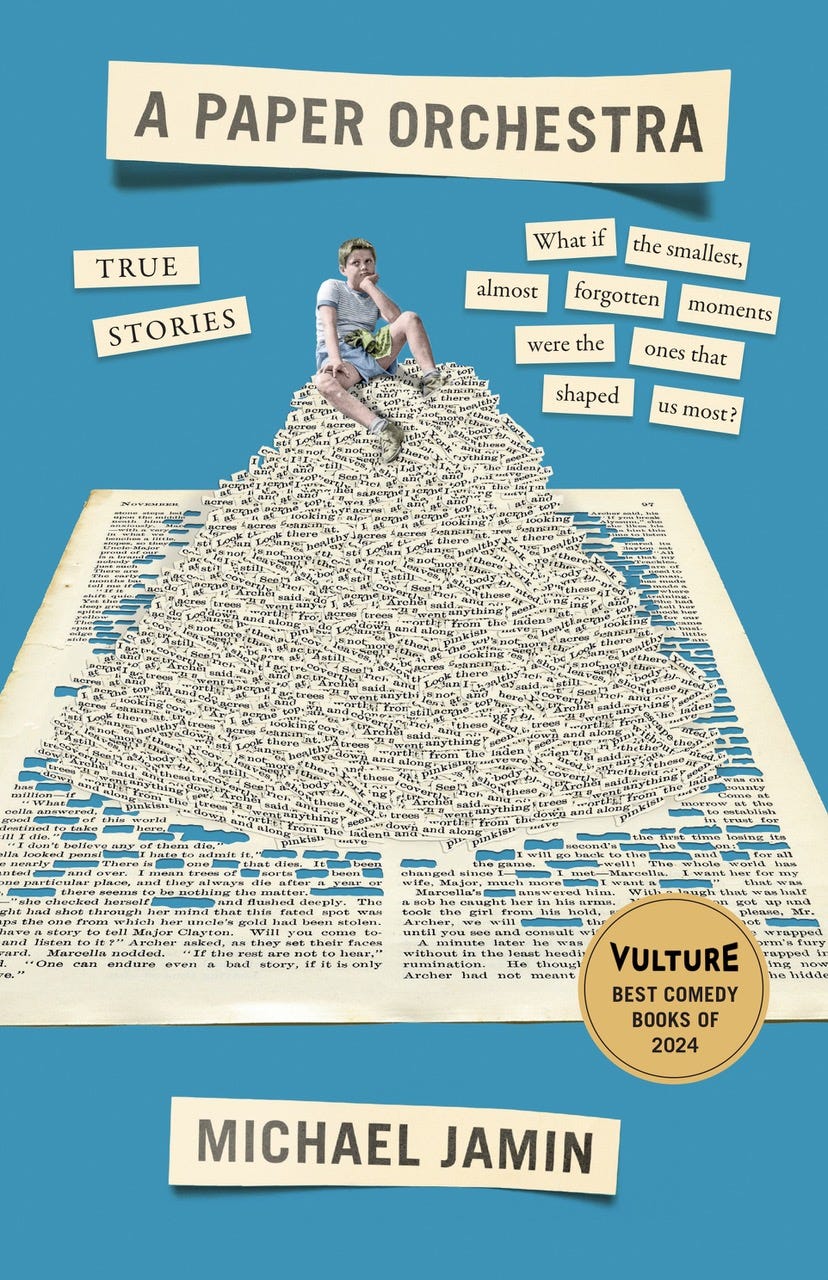
Here’s the 136th installment, featuring Michael Jamin, author of the true story collection, A Paper Orchestra. - Sari Botton
P.S. Check out all the interviews in The Memoir Land Author Questionnaire series.
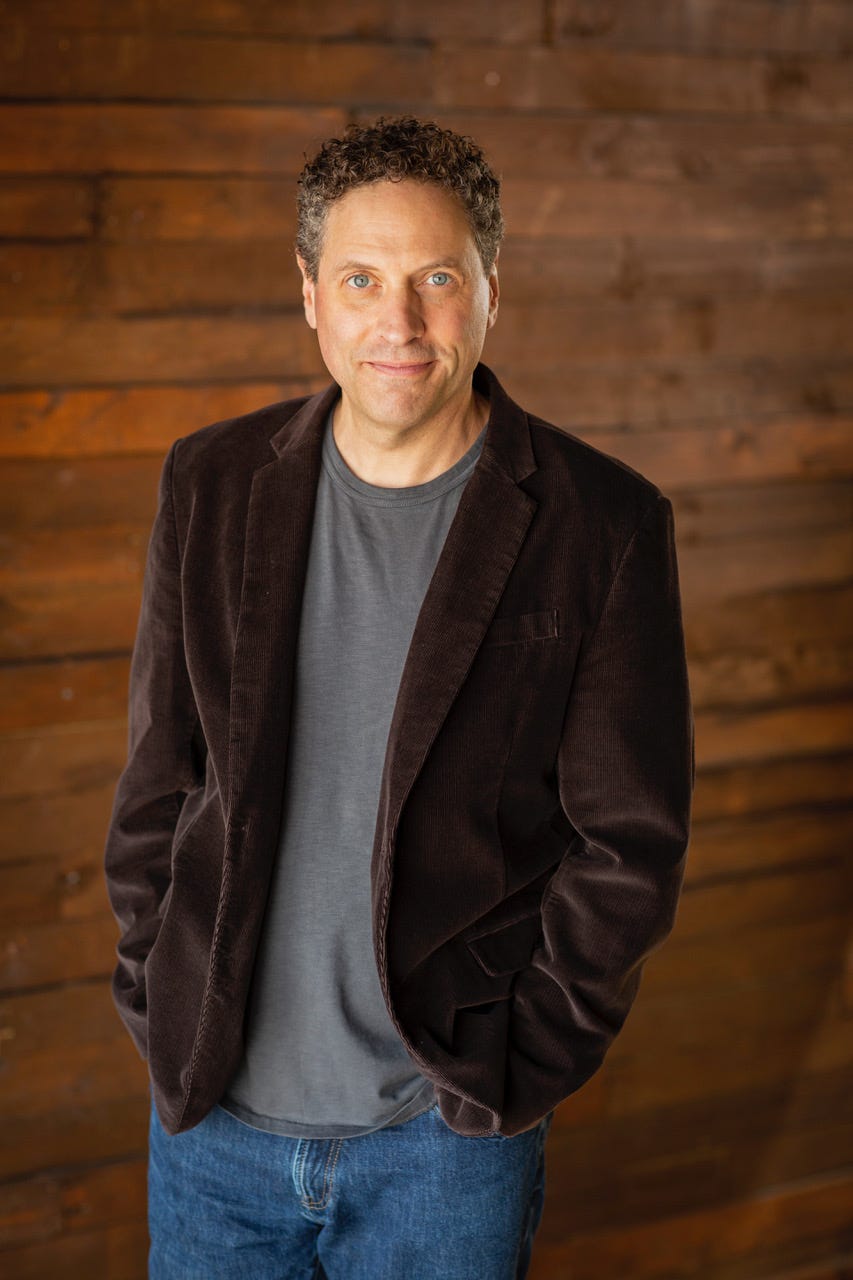
Michael Jamin has a been a TV writer/showrunner for 28 years. His many credits include King of the Hill, Beavis & Butt-Head, Just Shoot Me, Wilfred, Maron, Rules of Engagement, Brickleberry, and Tacoma FD. He’s also the author of A Paper Orchestra, a collection of true short stories, which Vulture named “Best Comedy Books of 2024.”
—
How old are you, and for how long have you been writing?
I’m 55. I’ve been writing professionally since I was 24.
What’s the title of your latest book, and when was it published?
A Paper Orchestra. It was published in 2024.
What number book is this for you?
This is my first.
When we think about the moments that change our lives, our minds often go to the big ones: surviving an accident, landing a dream job, or winning the lottery. But what if that’s wrong? What if the smallest, almost forgotten moments were the ones that shape us most?
How do you categorize your book—as a memoir, memoir-in-essays, essay collection, creative nonfiction, graphic memoir, autofiction—and why?
I’ve always loved the work of David Sedaris. He writes personal essays, so originally I thought I’d write my version of what he does. However, because of my background as a TV writer, my essays felt more like stories. They were less observational and more plot driven. My book is really creative nonfiction, but for most people, I think it’s easier to describe them as “true short stories.”
What is the “elevator pitch” for your book?
When we think about the moments that change our lives, our minds often go to the big ones: surviving an accident, landing a dream job, or winning the lottery. But what if that’s wrong? What if the smallest, almost forgotten moments were the ones that shape us most?
What’s the back story of this book including your origin story as a writer? How did you become a writer, and how did this book come to be?
This is actually one of the stories in my book. When I was a student at Princeton University, I applied to the creative writing program. I was rejected. Twice. After graduation, I moved to Los Angeles to pursue a career in TV writing. Fortunately, I made it.
As a TV writer, I think people are surprised to learn that I don’t write what I want to write. I write what people pay me to write. It’s a great way to make a living, but after two decades of doing this, it made writing feel like a job.
One day, I had a horrible idea and I shared it with my wife. I told her I was thinking of writing a collection of personal essays, and if I did it would take me years to write it, and even if I sold it, I’d barely make any money.
She said, “Oh my God. You have to!”
She thought it would help me find myself, and she was right. As a TV writer, I have to figure out who my characters are deep down and what drives them to make the decisions they make. In the case of my memoir, I was the main character, so I had to figure out who I was. To be honest, I wasn’t thrilled with the person I found.
What were the hardest aspects of writing this book and getting it published?
When I signed with my agent, he warned me that there wasn’t a lot of demand for another David Sedaris. If I were to go through with it, “platform drives acquisition.” That meant that, at least in this space, publishers want authors to have a large social media platform. After all, who’s going to read this kind of memoir from someone they’ve never heard of. It’s a fair enough point. I was just naively hoping that the strength of my writing would be enough.
Anyway, I told him to give me a year and I would come back with a half-million followers on social media. And that’s what I did. I began posting daily about my life as a TV writer on TikTok, Instagram and Facebook. Thanks to my followers, A Paper Orchestra became a bestseller.
The danger in writing memoir is that it can be horribly self-indulgent and narcissistic. It can easily scream, “Look how interesting I am.” So you have to change the energy. You have to tell the stories you don’t want to tell. Write about your weaknesses and not your strengths. Then it’s not “look how interesting I am” it’s “look how human I am.”
How did you handle writing about real people in your life? Did you use real or changed names and identifying details? Did you run passages or the whole book by people who appear in the narrative? Did you make changes they requested?
With the exception of my immediate family, all the names and identifying characteristics of the people mentioned have been changed. There’s a good chance that if they read it, they might not even know it was about them. Given that these people are not able to defend themselves in my book, I feel that’s the only way fair way to write a memoir. But truthfully, I’m much harder on myself than anyone else in the book. I’m the hero, but I’m also the villain.
There were two stories that heavily involved my children, so I asked for their permission before I published. Fortunately, both my daughters are artists so they understand. But again, if anyone in this book looks like a fool, it’s me.
Who is another writer you took inspiration from in producing this book? Was it a specific book, or their whole body of work? (Can be more than one writer or book.)
My biggest influence was David Sedaris. That guy could write a menu and I’d probably love reading it. I’ve read all of his books at least 3 times. Once for enjoyment, the rest to study how he writes.
What advice would you give to aspiring writers looking to publish a book like yours, who are maybe afraid, or intimidated by the process?
The danger in writing memoir is that it can be horribly self-indulgent and narcissistic. It can easily scream, “Look how interesting I am.” So you have to change the energy. You have to tell the stories you don’t want to tell. Write about your weaknesses and not your strengths. Then it’s not “look how interesting I am” it’s “look how human I am.”
I often tell people that my book, A Paper Orchestra, is a collection of confessions and apologies. That’s what makes it interesting and relatable. I’m just giving voice to the same thoughts that readers have, but might not be comfortable sharing.
What do you love about writing?
As a TV writer, people consume my work very passively. They turn on the TV and, to some extent, zone out. They might even watch my shows while simultaneously scrolling on their phone.
But as an author, readers are committing themselves fully. They’re holding my work in their hands for hours. Maybe lying in bed. Maybe on the bus to work. They’re not channel surfing. They’re not checking their emails. They’re tuning everything else just to hear my words in their head. It’s such a huge honor to me. When someone buys my book from my website, I take the time to write a short note in each one. To me, that’s the very least I can do in exchange for this honor.
What frustrates you about writing?
Sometimes, now matter how hard I try with an idea, I simply can’t find the story. I thought there was one in there, but I was wrong. Not every idea can be turned into a compelling story, not matter how hard we try. When that happens, you can’t force it. You have to give up on it an move on to something else.
What about writing surprises you?
In my 28 year career as a TV writer, my work has been seen by hundreds of millions of people. Yet only once have I received fan mail for something I wrote on television. My book, on the other hand, has been read by not even a fraction of those people. Not even a sliver. But I constantly have readers reaching out to me, telling me how moved they were by my book.
Something very intimate happens when a reader holds your book in their hands, spending hours alone with the author, hearing their words in their head. Reading a book is incredibly powerful that way.
Does your writing practice involve any kind of routine, or writing at specific times?
I prefer to write in the morning, when I’m freshest. But at night, just as I’m laying my head on the pillow, is when I do most of my thinking. I’ll rehash the story I’m currently working on and think about the next day’s work. Questions I often ask myself are: Where’s the joy in this scene? Is there a bridge scene I can make more engaging? What am I building to? etc.
In my 28 year career as a TV writer, my work has been seen by hundreds of millions of people. Yet only once have I received fan mail for something I wrote on television. My book, on the other hand, has been read by not even a fraction of those people. Not even a sliver. But I constantly have readers reaching out to me, telling me how moved they were by my book.
Do you engage in any other creative pursuits, professionally or for fun? Are there non-writing activities do you consider to be “writing” or supportive of your process?
Sadly, screenwriting is my profession and writing memoir is my hobby. I’m not exactly well-rounded. I also write a Substack, where I share my thoughts on the Business and Craft of Writing. It’s called “What the Hell is Michael Jamin Talking About?” Doing so allows me to think about writing from the perspective of a student, and that helps me crystalize my process.
I tend to try activities that I wouldn’t ordinarily do, not because I’m open-minded, but because I know I’ll get a story out of it.
What’s next for you? Do you have another book planned, or in the works?
I’m already at work on my next collection, but I’m also busy touring with A Paper Orchestra. I perform it as a solo show. We’ve done shows in Los Angeles, New York, Chicago, Boston, Seattle, and San Francisco. By the time of this publishing, we’ll have added the Edinburgh Fringe and Philadelphia to that list.
I look at this as the third act of my life, and it’s been exciting to venture into something completely new and unfamiliar to me. Of everything I’ve ever written, A Paper Orchestra is the work I’m most proud of, and I’m so happy to share it with the world.
Previous to writing my memoir, I’d only published research texts and journal articles. They provide no opportunity for humor or self-reflection.
How liberating it was for me, post-retirement and late in life, to write my memoir “Men as Friends” about men friends I had loved and lost over the years. In it I could tell lots of funny stories as well as grieve their losses.
What surprised me was that I discovered that there were men who I called “friends” that I knew for many years, wrote books with, exchanged personal information, helped in crises whom I never loved and probably never loved me.
That discovery led me to a new and unanticipated place and a deeper understanding of the nature of friendship between men.
Loved this. Especially the subtitle/elevator pitch--I think that's true. Many of those tiny moments are what shape us. Thank you for this one.