


Since 2010, in various publications, I’ve interviewed authors—mostly memoirists—about aspects of writing and publishing. Initially I did this for my own edification, as someone who was struggling to find the courage and support to write and publish my memoir. I’m still curious about other authors’ experiences, and I know many of you are, too. So, inspired by the popularity of The Oldster Magazine Questionnaire, I’ve launched The Memoir Land Author Questionnaire.
Here’s the 245th installment, featuring Cara Benson, author of An Armsful of Birds: A Personal Field Guide to Love, Loss, and Commitment. - Sari Botton
P.S. Check out all the interviews in The Memoir Land Author Questionnaire series.
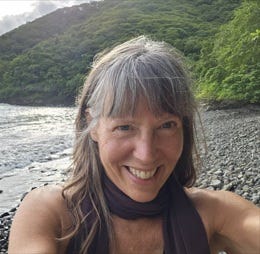
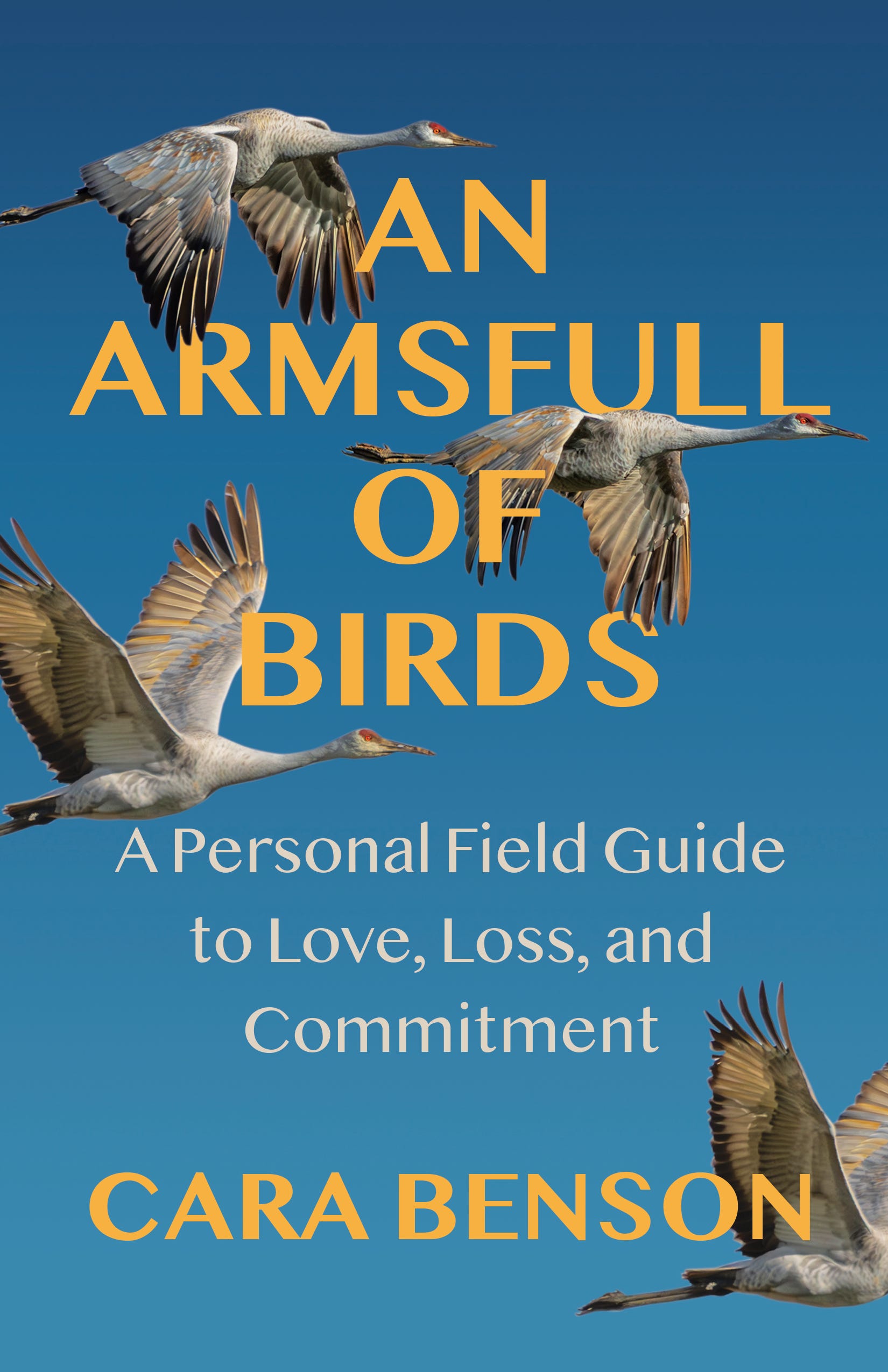
Cara Benson is the author of the memoir An Armsfull of Birds: A Personal Field Guide to Love, Loss, and Commitment. Other writing has been published in The New York Times, Huffington Post, Boston Review, Sierra Magazine, Orion, Los Angeles Review of Books and selected for Best American Poetry. Her first book, a collection of prose poems called (made), was praised by the The Huffington Post and The Brooklyn Rail. Benson received a New York Foundation for the Arts Fellowship and lives and writes in a former church in the ancestral homelands of the Stockbridge Munsee Band of Mohicans in upstate NY. www.carabensonwriter.com.
—
How old are you, and for how long have you been writing?
I’m 59. I’ve been involved in some form of creative expression since I wrote my first poem at the age of 5 (though apparently I was quite expressive even in the womb). As far as pursuing it vocationally, I went to NYU film school as an 18-year-old and also took part in the performance poetry boom in NYC that was happening at that time. This would have been the late 80s/early 90s. So I’ve come a long way, baby.
What’s the title of your latest book, and when was it published?
An Armsfull of Birds: A Field Guide to Love, Loss, and Commitment published this year (2026).
What number book is this for you?
Of published single author books, this is my second. My first was a collection of interconnected prose poems called (made), and I’ve edited a few anthologies.
I also want to mention a mixed-media autofiction novel I wrote that went out on submission a few weeks before COVID shutdown. Clearly, that timing sucked. Though the book didn’t picked up, an excerpt of it did publish at The Brooklyn Rail under the working title What Would Emma Goldman Do? I loved that novel! But such is the reality of publishing.
Also, though, I think about what Somerset Maugham wrote in his intro to Of Human Bondage. Something about having written an earlier version of his mother loss story and how that met with no success. But he was ultimately grateful for that rejection because he might not have written the later novel if that first one had gotten picked up. So who knows how a work not finding its audience will impact a writer’s life.
Would I have written An Armsfull of Birds the same way if the previous novel had been published? I’ll never know. But Armsfull is absolutely the book it’s supposed to be—given the circumstances—so there’s comfort in that.
All that to say that though An Armsfull of Birds is my second published book, it’s not my second book, to my mind.
When Jon died by suicide, the last thing I wanted to do was write for an audience or readership. I was process-writing, letters to him and to the universe that I made offerings of, journaling, etc., but nothing that I shared beyond a therapist’s office or in sacred circles. In fact, I was repulsed by the idea of writing about his death. I would not make art of it. Joan Didion be damned.
How do you categorize your book—as a memoir, memoir-in-essays, essay collection, creative nonfiction, graphic memoir, autofiction—and why?
Pull-up-your-chair-I’m-going-to-tell-you-a-story memoir. I’ve heard it’s a page turner, an intimate story that won’t let you go once you start it. Readers feel as if I’m right there with them, talking to them. Which is similar to how I felt in writing it; the story took hold of me and wouldn’t let me go until I finished it.
What is the “elevator pitch” for your book?
An Armsfull of Birds: A Personal Field Guide to Love, Loss, and Commitment is a memoir about crawling out of low bottom addiction, committing to a relationship with a man I meet in recovery, then losing him to suicide. It’s a love story. A survival journey. A model for healing ourselves and the natural world that needs us so desperately. As novelist Amy Shearn says, it’s a memoir that will break your heart and put it back together again.
What’s the back story of this book including your origin story as a writer? How did you become a writer, and how did this book come to be?
I never thought I’d write about my partner’s death by suicide. I was already a writer, but the closest I’d come to the personal in my writing was the autofiction I mentioned. I wasn’t willing or ready to be that vulnerable on the page yet. It’s partly that, but also I was working on other projects—exploring the plasticity of the medium to see what words could achieve. I was entranced by the poetic function of language, if you will.
I started the autofiction because I needed to make sense of just what the fuck I was doing being a poet in late stage capitalism, holding a mortgage with my partner. How could I live my politics and my poetics? I didn’t know. So I started exploring that in my writing. That novel got a lot closer to the bone, so to speak, of my own narrative.
When Jon died by suicide, the last thing I wanted to do was write for an audience or readership. I was process-writing, letters to him and to the universe that I made offerings of, journaling, etc., but nothing that I shared beyond a therapist’s office or in sacred circles. In fact, I was repulsed by the idea of writing about his death. I would not make art of it. Joan Didion be damned.
After years of bereavement counseling and healing, I returned to writing as a creative tool. It was the pandemic, and I began writing about walking in the woods to take readers who might be cooped up in city apartments with me into the forest. These pieces started becoming a lot more personal—we were all sharing so intimately on the internet in lockdown—and the circumstances of my being in these particular woods, behind the church where I now live, were a result of having lost my partner. That story started to leak into the writing. And then it insisted on being told.
What were the hardest aspects of writing this book and getting it published?
The book sold on proposal. I wasn’t willing to go through the experience of writing about such a gutting time in my life if it was going to die on submission. But once it sold, I was all in. I wrote it in a year.
But I don’t want readers to think that the book is only about tragedy. It truly is a light- and love-filled book. And there’s humor, too. I spit all over myself on our first date. Plus, I got to spend time with my beloved again, to be alive in our house. In our snuggling and our running jokes. And then I move into the woods after he’s gone and am buoyed by all my creaturely neighbors—the mink and fox and ermine and bear and coyotes. Knowing that I had the life I’ve been building after his death to get to in the story kept me going.
Plus, I got to hear him while writing it. Whenever I got stuck, I’d wonder what he would say to me. “Bense”—he called me Bense—“they don’t need to know that.” Or: “You’re going to tell them all of this?” And: “Hey! Remember when we….” That got me through. That loving relationship really comes through in the book because it’s still so alive for me, even still.
After years of bereavement counseling and healing, I returned to writing as a creative tool. It was the pandemic, and I began writing about walking in the woods to take readers who might be cooped up in city apartments with me into the forest. These pieces started becoming a lot more personal—we were all sharing so intimately on the internet in lockdown—and the circumstances of my being in these particular woods, behind the church where I now live, were a result of having lost my partner. That story started to leak into the writing. And then it insisted on being told.
How did you handle writing about real people in your life? Did you use real or changed names and identifying details? Did you run passages or the whole book by people who appear in the narrative? Did you make changes they requested?
I didn’t run passages past anyone, but I did get clarification on some things. And the people I named, I checked with them on that. There was only one person who wanted to be renamed, which I honored.
I was very careful not to throw anyone under the bus in the book. And there were people I wanted to keep out of it as much as possible. I didn’t want anything to detract from my mission of creating a love-filled story that could ultimately uplift those who read it and keep them in the game at this particularly challenging time on the planet. So I don’t think there’s anything in the book that would insult the people who were in the orbit of its story as it happened. Or mostly not, and I’m good with that.
Who is another writer you took inspiration from in producing this book? Was it a specific book, or their whole body of work? (Can be more than one writer or book.)
Terry Tempest Williams, Anne Lamott, and Cheryl Strayed’s Wild.
What advice would you give to aspiring writers looking to publish a book like yours, who are maybe afraid, or intimidated by the process?
Nothing new here, but remember that rejection will inevitably be part of the process. It can feel impossible some days, but do not take it personally. I once asked Grace Paley later in her career if she ever got rejections at that point. She said she did! I asked what she did when that happened. She said that she’d say to her husband about the person who’d not taken the piece: “That jerk!” And then laughed. I love that.
What do you love about writing?
Exerting control over the world through language. When I’m writing, what I say goes!
What frustrates you about writing?
The days that the words will not cooperate. I wrangle with them and twist, and tug. Pull. Get scratched up and reminded that I am not in control, after all.
What about writing surprises you?
How simultaneously expansive and limiting language is. Is a word the finger pointing at the moon or the moon? It’s neither! It’s the mallet on the strings of our imagination that sets them to vibrating. I’m calling up Wittgenstein, here. And classical Chinese poets. Also, the Octavio Paz line that it’s in the eating that the apple has its taste. It’s in the reader that the writing has its meaning. What I’m surprised about is that these little missionaries can march their way directly into a reader’s or listener’s heart and create a whole world. (Look how messy my metaphors are!)
Does your writing practice involve any kind of routine, or writing at specific times?
Morning is my best writing time at this point in my life. When I was much younger and had romantic (and dysfunctional) notions of what being a writer meant, I thought scribbling on bar napkins late into the night was how I’d find my best material. I still have some of those napkins, and I can assure you that I was wrong about that.
For years now I’ve had a fairly good routine about showing up to the work day in and day out. Which isn’t to say that I, like most writers, never want to avoid writing. I’m never hungrier than when I open up the document I’m working on. Or suddenly it becomes urgent to do laundry, snuggle with my cats, get outside.
So I have other writers I text with. I keep them posted on my progress. I might send a word count, or that I did revision, or that I was able to get two sentences down, which I count as a win some days. I’ve got others cheering me on. And I them! It helps—a lot.
I don’t want readers to think that the book is only about tragedy. It truly is a light- and love-filled book. And there’s humor, too. I spit all over myself on our first date. Plus, I got to spend time with my beloved again, to be alive in our house. In our snuggling and our running jokes. And then I move into the woods after he’s gone and am buoyed by all my creaturely neighbors—the mink and fox and ermine and bear and coyotes. Knowing that I had the life I’ve been building after his death to get to in the story kept me going.
Do you engage in any other creative pursuits, professionally or for fun? Are there non-writing activities you consider to be “writing” or supportive of your process?
Hiking—whether the kind of aggressive hiking that helped me to get and stay sober (and still helps me to stay sane) or wandering in the woods, sticking my nose into crevices and tree trunks—feels like writing with my body.
What’s next for you? Do you have another book planned, or in the works?
I’m working on the film/tv treatment for Armsfull. I’m finding that I’m really energized by being in the process of telling the story through a visual medium. It’s a completely different language.
Such an infinite process writing is! You express it wonderfully
I've never thought about an unpublished book quite this way before. You really don't know what you might have written differently—or never written at all—if the earlier one had been published.
Also, Grace Paley saying “That jerk!” when she got rejected later in her career is fantastic. 😂 I'm keeping that one.