

Five Incursions
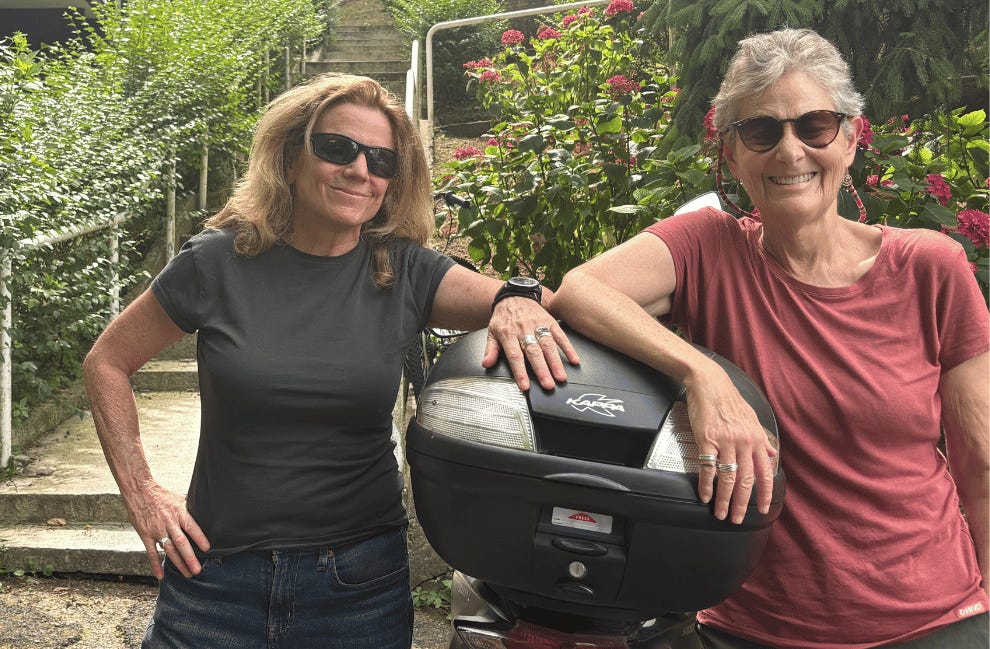
Diana Friedman and a friend compare the scars they've collected over many surgeries and years.

Five incursions into my abdominal cavity have netted me the following: confirmation of a cancer-free colon, excision of a tumorous cervical cyst, removal of a poorly effusing gall bladder, and delivery of a baby girl, followed four years later by a baby boy.
My friend Carol likes to show off photos of her abdominal scars from when the doctor removed her cancerous stomach tumor. She prefers the early post-op shots. Not because the markings are so dramatic, which they are—red, fiery lightning bolts—but because in that photo she is wearing snug-fitting, purple-pink underwear and finds it very attractive. I agree.
Carol and I are quite competitive, and when I told her that I received four incisions for my gall bladder removal, a few weeks after her surgery, she announced, “I win!” No question—in the upper abdominal zone she’s got me beat in the scar count. However, she can’t match the long pink Frankenstein stitch above my pubic bone. Because what did I get for that one? Two adorable infants, now mildly adorable adults.
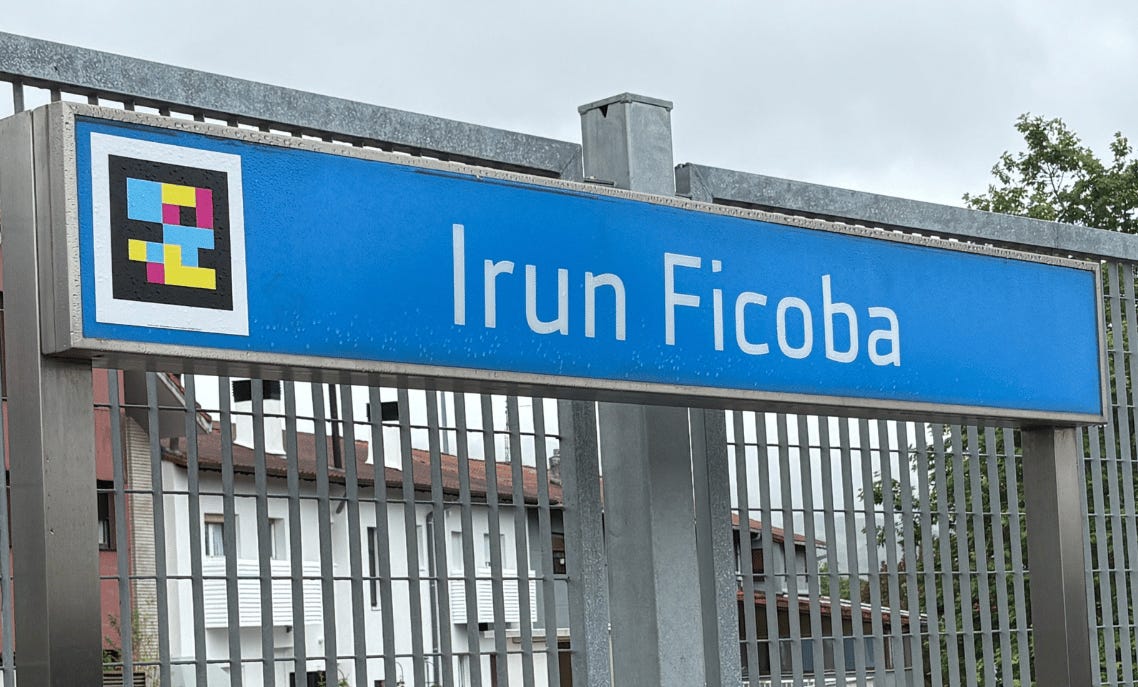
Carol’s cancer is in remission but that doesn’t stop her from showing off her scars in crowded spaces, say, at an eco-fair in Spain, where she lives year-round and I live part time. The fair is in Irun Ficoba, on the border with France and later, when we have time before our train returns us to San Sebastian, we walk past the sad souvenir shops selling key chains, bottle openers, shot glasses—tacky knick-knacks to make you feel you’ve been somewhere exotic. The trinkets send us into fits of reminiscence about how much seedier this borderland was when borders still existed between Spain and France. It has been so long, we don’t remember: Did we have to show our passports every time the train crossed the Bidasoa River from Irun into Hendaye? What does it mean, not only for us, but all the young people who never knew it, that this border no longer exists?
My friend Carol likes to show off photos of her abdominal scars from when the doctor removed her cancerous stomach tumor. She prefers the early post-op shots. Not because the markings are so dramatic, which they are—red, fiery lightning bolts—but because in that photo she is wearing snug-fitting, purple-pink underwear and finds it very attractive. I agree.
Is that how surgeons think of the multiple layers of epidermis and muscle that safeguard our abdominal cavities? Not as a border, but a pliable mass to infiltrate to extract renegade cells and organs, a territory to enter freely to forestall the inevitable crossing from life to death?
Anyway, before that walk, before we leave the fair and contemplate the absence of borders, political, abdominal and otherwise, Carol asks if my scars have healed. I tell her yes, they have faded and are barely noticeable. She starts to describe hers, then says oh fuck it, and jumps off the wall and lifts her shirt. In Spain, most women think nothing of removing their tops at the beach. I am not sure one does this inland, but Carol does not stop to contemplate, just lifts her shirt.
Her scars streak across her abdomen, still angry red. She sucks in her stomach, and like magic, they shrink, vanishing into what little belly fat she has. The same way, I imagine, her tumor did. When she was first diagnosed, her tumor extended its tendrils so far into nearby organs the surgeon refused to operate. But oral chemo shrunk everything enough the doctor felt it worthwhile to venture into her abdomen.
And here she is. Five incursions and five scars to show for it.
* * *
Before my first abdominal incursion—my daughter’s birth by C-section—I’d never thought about what happens when your abs don’t function. So when the nurse removed the catheter one day later and encouraged me to walk to the bathroom, I was shocked to find I couldn’t sit up, the muscles connecting my bottom half to the top non-operational.
When I met with the surgeon in his office to prepare for my gall bladder removal some twenty-five years later, I felt only mildly nervous because I knew what to expect about my midsection going offline. Especially after he told me the surgery was minimally invasive.
But then he said: You are in good hands. If we can’t complete the removal using the camera, I am old enough to remember how to go in with a knife.
The knife did not sound like an ideal alternative, but if someone is going to insert instruments into your abdominal cavity to remove an organ, then experienced hands are what you want, and I remained reassured. But at that moment I was fully clothed and did not have an IV in my hand, nor was my abdomen slathered in antiseptic, and three days later, when they lifted me off the bed in the freezing pre-op room onto the stretcher and started pumping sleeping drugs into my IV, I burst into tears. I’d forgotten how during my son’s birth twenty years earlier, I’d almost lost consciousness. After two days of labor, hours of Pitocin and only dilating to three centimeters, we all agreed it was time for a C-Section. When they strapped me to the table, though, the room started flashing, lights on, lights off, lights on, lights off. I felt myself being dragged under a dark curtain, the same way sleep commands your body. But this was not sleep, this felt like death, a dark place from which I knew I would not return. I pleaded with the doctors to do something, but they insisted I was fine. Finally, the nurse midwife, realizing I hadn’t eaten in two days, suggested glucose for my IV. That stopped the flashing and the sinking, but then my arms and legs began trembling uncontrollably.
Carol and I are quite competitive, and when I told her that I received four incisions for my gall bladder removal, a few weeks after her surgery, she announced, “I win!” No question—in the upper abdominal zone she’s got me beat in the scar count. However, she can’t match the long pink Frankenstein stitch above my pubic bone. Because what did I get for that one? Two adorable infants, now mildly adorable adults.
The surgical nurse prepping me for the gall bladder operation, upon seeing my tears, told me to imagine Santa Claus coming down the chimney naked, and that made me laugh, and the next thing I knew, I was in recovery and everything was fine. Until the following day when I woke with blistered bumps exploding across my abdomen; an allergic reaction to the antiseptic. I lay in bed for three days, high on narcotics, staring at my rash-ridden mid-section, convinced the bumps were a somatic manifestation of my body’s discontent at being vandalized.
And wondering:
What does the abdominal cavity think about all of this?
How does it manage the cognitive dissonance? The paradox of serving as the vessel for both the nexus of life and death.
And how do we make sense of it?
Can we?
* * *
After Carol’s surgery, the doctor was optimistic. He’d found only two microscopic cancer cells in her abdominal cavity, easily contained with meds.
This is ironic because Carol is not someone who can be contained. I mean this in the nicest possible way.
When Carol and I are not at eco-fairs, we like to explore the Spanish countryside where she steers her Honda down narrow roads with steep cliff-side drop-offs in search of hidden lakes. One day we go looking for a swimming hole along the Bidasoa River in Navarra and she veers off the highway, pointing the car down a green way—a bike path. When I mention that we are driving on a path meant for two wheels—plus the likelihood there might be no turnouts, Carol shrugs. She’s worked as a tour guide all over Spain. She is confident that if she keeps pushing forward, she will find what she is looking for.


Apparently, Carol also believes there is always a way back because she continues to steer the car down the narrow path, swerving under low branches while brambles scrape the car. Then she spots it: a small turnout. No swimming hole, but no bother. She stops, revs into reverse, the tires spinning at the edge of the drop-off above the river—my eyes closed, my hand glued to the passenger strap— and vroom. Back up the bike path to the road we go.
* * *
A week later, Carol invites me on a hike. But first, she takes me to her doctor’s appointment to show me the Oncology Center of San Sebastián where she has received her cancer treatment, all free of charge. It is a magnificent building composed of steel and glass and large windows allowing light to flood in. She tours me around the way I imagine she tours groups through the cathedrals along the Camino de Santiago, facing me with a big smile, her arms wide: Look at this beautiful open stairway, the light!
I agree. The building is designed to say: We may work with illness and death, but we want you to feel alive.
Upstairs in the waiting room, the carpets are clean, the couches plush. Parents and children and family friends sit together holding hands, colorful head scarves everywhere. Like Carol, they await results of their latest tests.
A week later, Carol invites me on a hike. But first, she takes me to her doctor’s appointment to show me the Oncology Center of San Sebastián where she has received her cancer treatment, all free of charge. She tours me around the way I imagine she tours groups through the cathedrals along the Camino de Santiago, facing me with a big smile, her arms wide: Look at this beautiful open stairway, the light!
I sit outside on the patio while Carol meets with her doctor. Although I am approximately 3600 miles away from New York City, a blazing sun beating down on my back, that oncology waiting room sends me straight back to a dark October night 15 years ago when I first saw my father unconscious in the Sloan Kettering ICU. They’d diagnosed his cancer days earlier, but it was moving so fast his systems had shut down. The ICU nurse gently told my stepmother and me to get his affairs in order. The next morning, we awoke to a phone call from my father, demanding we bust him out of the ICU. Within 24 hours, he was sitting in a chair in the step-down unit. During rounds, the doctors marveled at how the fast-acting chemo had worked, lifting our hopes. But then, the attending cautioned me that no one lives more than three months after reaching this stage. I stepped out of the room, my body collapsing into the reality I was going to lose my father in very short period of time.
It is impossible now, standing in the Spanish sun and thinking of those people upstairs clinging to hope, to not replay how many times my father’s doctors opened his body after that ICU visit and how they chased his cancer everywhere—his brain, his kidneys, his bladder. All the times they sliced and radiated him, and in so doing gave him five additional years. All the hurt my father and I were able to talk through, the additional hard-fought Scrabble games we played, the one time he allowed me to drive him to the Dia Beacon Museum outside the city and grudgingly conceded that I was, in fact, a good driver. All that extra time we would not have had.
My phone buzzes, and back upstairs I find Carol smiling. Everything is fine, just as she predicted. Nothing moved, nothing grew, nothing changed.
How lucky I am to have a friend who can leave an oncology appointment wearing the smile of someone who has been given a clean bill of health, even though she will always need to take meds and that cancer may live inside her forever. But for now, this is good enough and as she bounds down the steps, I understand something else: For Carol, there is not only a way back, but always a way forward, too.
Her five scars remain, fiery red, a reminder of what’s been removed. My scars persist too, not as fierce, but the incursions have all resolved fine. My kids are launched and text regularly and bring me thoughtful presents like lavender bath soap and Oolong tea from their travels to far-flung places. My colon is clean. My gall bladder and cyst were long ago recycled, transformed into another form of matter, the same way we all will be transformed someday.
Together, Carol and I walk to the parking lot. Our shirts hang loose over our pants, but our scars are tucked safely away. We hop into the car, ready to adventure, the lingering streaks and dots marking our abdomens a reminder that five incursions are really not that big a price to pay for however many more years in the sun we will be granted.
Diana Friedman is a writer, editor and writing coach whose essays, fiction and articles have appeared in a wide range of publications including Brevity Blog, Newsweek, Flyway, the Baltimore Sun and Huffington Post, among others. Diana is co-founder of KindWrite Studio, a full service writing studio that helps writers from gestation to publication. She also directs and facilitates creative writing retreats in the Basque Pyrenees of Spain, Maryland and Pennsylvania. She resides on Substack at Under the Red Pen, a newsletter for aspiring creatives who struggle with critical feedback, and is co-editing an anthology of short fiction from Maryland, due for release November, 2026. For their next adventure in the sun, Diana and Carol are scheduled to take on Puglia, Italy, by bicycle, this fall.
 | A guest post by
|
Love how personal and universal your warmly bold touched with humor writing is, Diana. We tell our stories in service to others. I especially love these two lines: "Two adorable infants, now mildly adorable adults." and "a territory to enter freely to forestall the inevitable crossing from life to death?" I know there's more wonderful stories you'll be sharing!
What a moving and thoughtful essay. I particularly enjoyed hearing about those precious five additional and healing years you had with Victor.